OLDER-TRAVELLER TRANSPORT GUIDE
A comfortable Sri Lanka trip for older travellers begins with precise choices, not a vague promise of a ‘senior-friendly’ vehicle. The useful booking connects a manageable step, supportive seat, working rear air-conditioning, realistic road days and a driver who listens without rushing.
Age alone does not describe what a traveller needs. One person in their seventies may walk steep paths confidently but dislike a high vehicle step, while another may need short walking distances, regular toilet stops or help carrying a case through an uneven hotel entrance.
This guide explains how to choose a Sri Lanka senior travel private driver, how to inspect the vehicle and how to design a lower-strain route. It also shows how to compare evidence and written quotes through driver profiles rather than accepting the first general assurance.
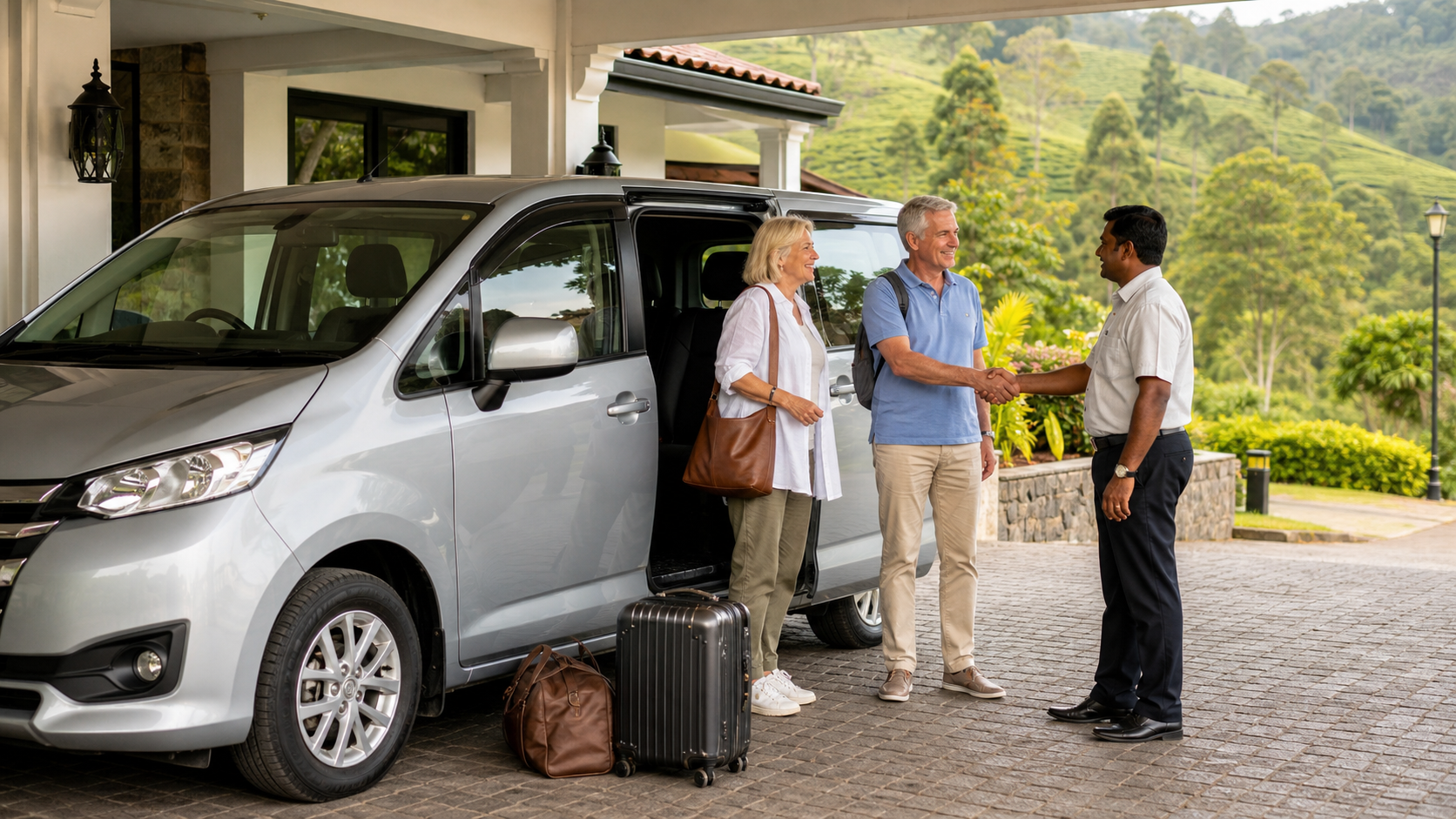
Sri Lanka for older travellers: the short answer
A private car with one suitable driver can reduce repeated lifting, unfamiliar transfers and daily transport negotiation. It can also keep water, medication, a light layer and the day bag within reach while allowing the group to change a stop when energy or weather changes.
The advantage is practical rather than automatic. Sri Lanka Tourism warns that travel around the compact island can still be time-consuming and lists multi-hour road journeys from Colombo, so use a private driver to create a calmer schedule as described in the official Sri Lanka transport guidance.
Boarding
Check step height, door opening, grab points and the space needed to turn and sit.
Seating
Confirm supportive seats, legroom, working belts and rear air-conditioning.
Pace
Reduce long uninterrupted road sectors and agree useful rest stops before travel.
Access
Ask about the real walking surface, stairs, shade and vehicle pickup point at each stop.
For many older travellers, a good plan means fewer hotel changes, one main outing on most days and an agreed stop before stiffness, heat or fatigue becomes a problem. It does not mean removing every temple, wildlife park or hill-country experience from the route.
Start with the traveller, not the age label
A useful quote request describes movements and preferences: whether the traveller can use one stable step, whether they prefer the front passenger seat or an upright rear captain’s chair, and how far they can comfortably walk on an uneven surface before resting. It should also say how often a toilet or seated rest is usually helpful.
These answers are more useful than writing ‘two seniors’. They help a driver recommend a real vehicle and timetable, and they make it easier to reject a generic reply that avoids the details.
Separate independence from assistance
Ask what help is welcome and what is not. A driver may be expected to lift suitcases, bring the vehicle closer to an entrance or explain where the least demanding path begins, while the travellers may prefer to board independently and manage their own personal items.
Clear boundaries protect dignity and reduce awkward assumptions. If hands-on assistance is genuinely required, confirm whether the driver can provide it safely; ordinary private-driver service should not be presented as trained personal care.
Choose the vehicle by boarding geometry
Seat count says almost nothing about ease of access. A tall SUV can offer good road clearance yet require an uncomfortable climb, while a low sedan can be difficult to rise from.
A minivan with a wide sliding door may be helpful, but only if the first step and seat position suit the individual.
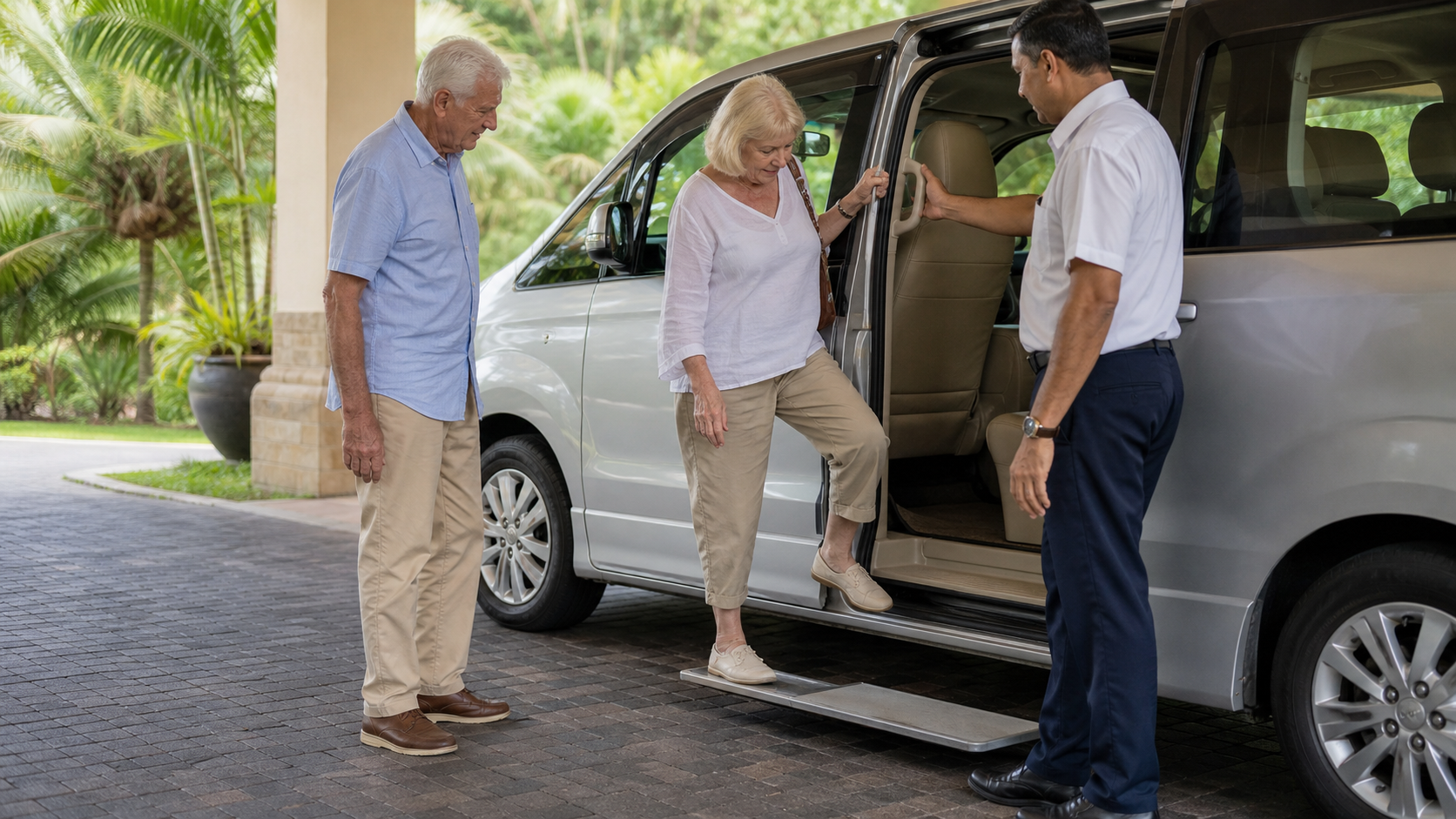
Inspect the complete movement
Imagine the sequence from standing beside the vehicle to sitting with both feet inside. Check whether the door opens far enough, a stable handhold is reachable before the first step and another passenger can wait nearby without blocking the driver or traffic.
Repeat the test for the preferred seat, not the easiest seat in the vehicle. The rear row may have more space once seated but require a narrow turn or climb past another seat.
Scroll horizontally to view all four columns →
| Vehicle point | What to inspect | Why it matters | Evidence to request |
|---|---|---|---|
| Door and first step | Door width, sill height, stable step and reachable grab point | A vehicle can be spacious inside but awkward to enter repeatedly | Side-on photograph with the door fully open and step visible |
| Seat and legroom | Upright support, seat depth, knee room and an easy path to the preferred seat | Long road days amplify a poor seating position | Current interior photograph from the open door, not a catalogue image |
| Cooling and shade | Rear vents, adjustable airflow, window shade and clean working controls | Front-cabin cooling does not prove that the rear row stays comfortable | Vent location, seating plan and confirmation that rear cooling works |
| Luggage access | Boot height, storage with every seat upright and access to medication or a day bag | Loose bags can block the aisle or force repeated lifting | Boot photograph with the stated luggage list and passenger rows in use |
The outer table is deliberately the same width as the article body; the four-column comparison scrolls inside it on desktop and mobile. Use the same method when reviewing any wide vehicle specification from a driver.
Check seating, cooling and luggage together
A supportive seat should allow a natural upright position with usable knee and foot space. Ask whether the backrest angle is adjustable, whether the seat belt closes without twisting and whether the preferred seat can remain available after all luggage is loaded.
Rear air-conditioning needs its own confirmation. A cold front cabin does not prove that the second or third row stays comfortable in traffic, and bags should not block vents or the aisle.
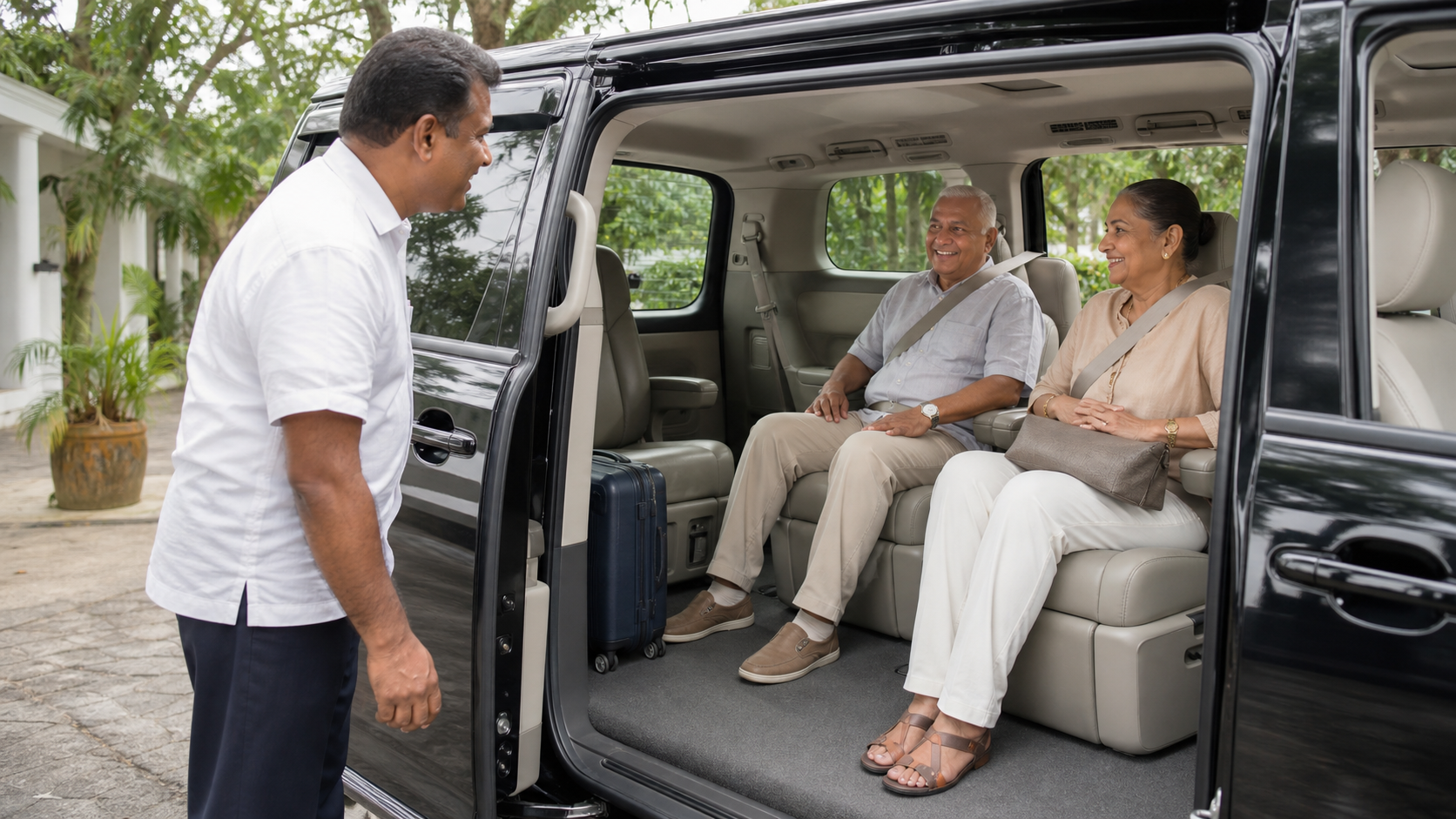
The 2026 private-driver cost guide explains why a larger vehicle can change the price. Pay more only when the larger model solves a real access, seat or luggage problem; exterior size without interior evidence is not a comfort guarantee.
REAL TAXI-CHARTER GUESTS
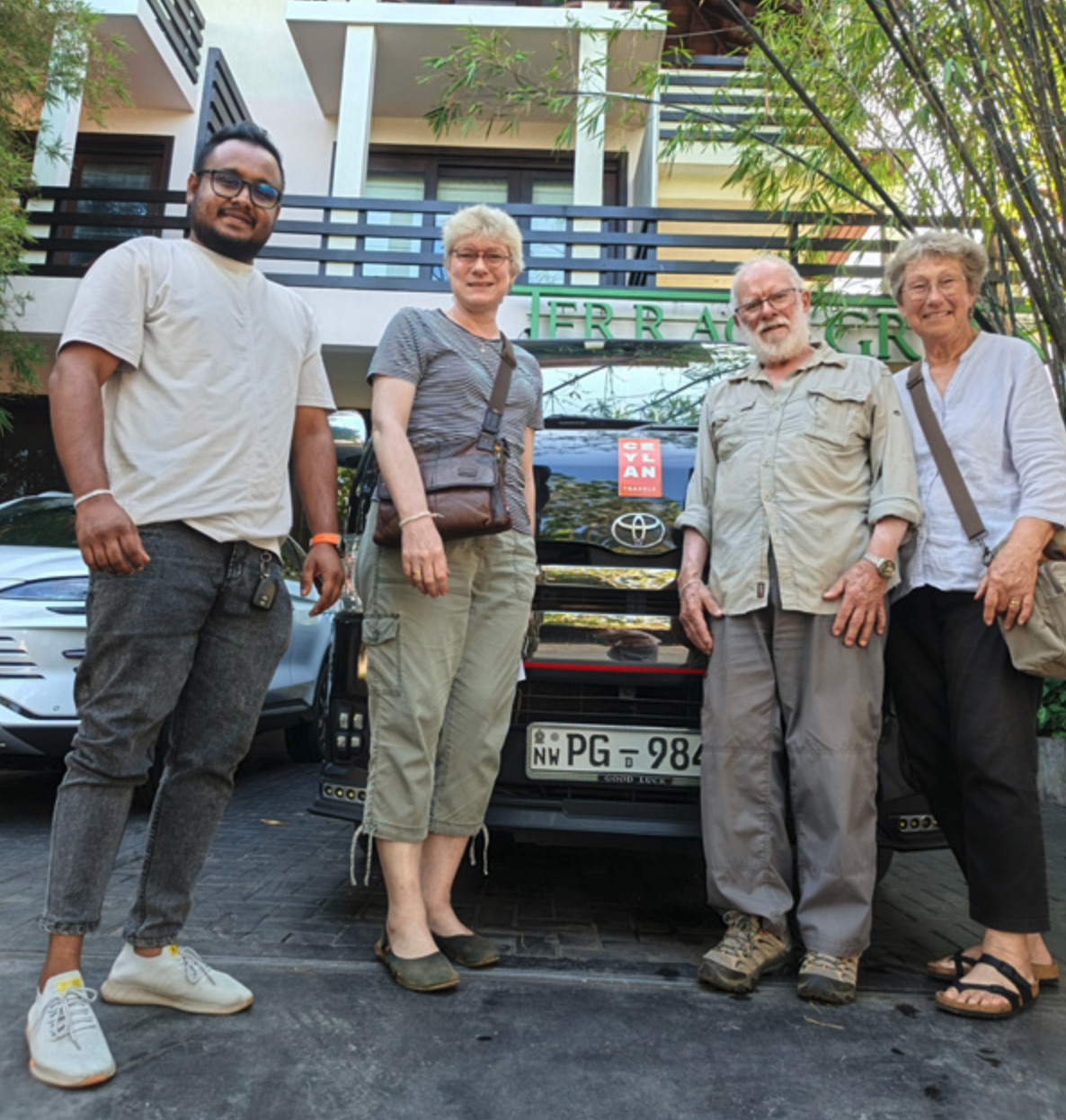
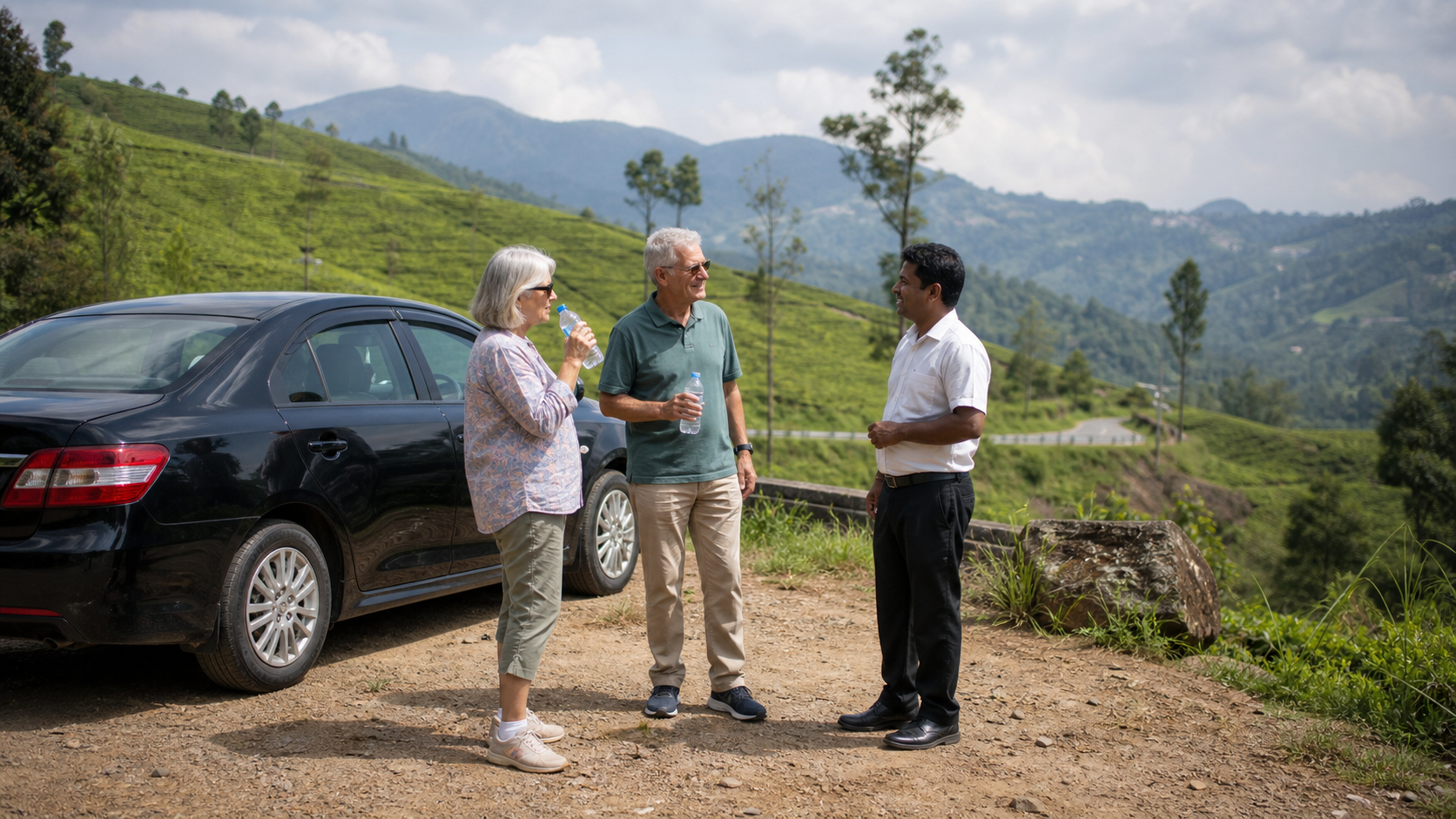
Real older travellers using private transport in Sri Lanka
These photographs show two useful stages: confirming a practical charter vehicle and combining road transport with a scenic train sector.

Choose a driver for patience and communication
The right driver does more than agree to frequent stops. They explain likely road time honestly, avoid turning every pause into a complaint, park where boarding is safer and listen when a traveller asks for smoother acceleration or an earlier return.
Look for specific review evidence about calm driving, punctuality, helpfulness and handling a flexible itinerary. General five-star praise is useful, but comments from travellers with similar pacing or mobility needs are more informative, so compare them through the traveller-review collection.
Confirm who will actually drive
Ask for the named driver, current vehicle and substitution rule. The driver-selection guide explains how to compare licences, profiles, reviews and red flags, while the chauffeur-guide comparison helps decide whether the trip needs transport only or deeper guiding.
A polite, patient person is not automatically a safe long-distance driver. The booking should also cover vehicle condition, seat belts, realistic duty hours, nighttime driving and the way concerns can be raised during the trip, using the separate practical safety guide for those checks.
Build a lower-strain itinerary
Start by removing unnecessary hotel changes. Staying three nights instead of two can turn one packing morning into a flexible local day, and a driver can wait at the hotel while the travellers decide whether to add a short outing.
Place the most demanding walk early in the day, but do not force an early departure after every hotel change. Alternate cultural sites, scenery and rest so the route has recovery built into it rather than relying on a free afternoon that may disappear after delays.
Plan by road time, not map distance
A short line on the map may include town traffic, bends, slow climbs and stops. Ask the driver for realistic door-to-door time, then add a proper break rather than treating a toilet stop as the only pause.
CDC guidance on travel-associated blood clots advises including car breaks to stretch and walk. The appropriate interval and any individual medical precautions should be discussed with a qualified clinician, especially when a traveller has additional risk factors.
Use a simple day-shape
COMFORTABLE TRIP NEXT STEP
Compare the driver, vehicle and daily pace as one complete setup.
LankaRide is useful at this stage because travellers can compare vehicle types, service categories and review evidence before sending the same mobility, luggage and itinerary brief to several suitable drivers.
Confirm the named driver, exact vehicle, route and any assistance requirements directly before travel. A directory listing cannot replace a personal suitability check.
Treat accessibility as a place-by-place question
The United States Department of State says accessibility can be limited in many Sri Lankan buildings and notes that damaged sidewalks and busy crossings can make movement difficult. That does not mean every site is inaccessible; it means a general promise such as ‘Sri Lanka is senior-friendly’ is not enough without checking the current Sri Lanka accessibility information.
For each important attraction, ask about the surface from vehicle to entrance, the number and height of steps, handrails, shade, seating, toilets and the closest practical pickup point. Hotel access deserves the same attention because a beautiful room can still involve stairs, a long slope or a distant vehicle entrance.
Create an A-plan and a lighter B-plan
The B-plan should be a real alternative, not simply cancelling the day. If a steep viewpoint feels wrong after rain, the driver might substitute a lower viewpoint, garden, museum, scenic tea stop or earlier hotel arrival.
Write this flexibility into the route brief so the driver understands that success is measured by comfort and enjoyment, not by completing every pin on the map.
Manage heat, medication and health planning responsibly
CDC advises older international travellers to discuss their itinerary, health concerns and medicines with a healthcare provider or travel-health specialist before departure. Its guidance for older adults also recommends carrying appropriate health records, enough medication for the trip and a plan for care overseas.
The driver can support a plan by keeping a day bag accessible, avoiding unnecessary time in a stationary hot vehicle and locating a suitable stop. The driver should not be asked to change medication, diagnose symptoms or make individual hydration rules.
CDC heat guidance notes that adults aged 65 and over can be more prone to heat-related health problems and recommends staying cool and hydrated, subject to individual medical advice. Confirm working rear air-conditioning, carry water and schedule exposed visits for a more suitable time of day.
A comfortable route pattern for ten to fourteen days
A slower circuit usually works better when it has longer bases and fewer one-night stays. The exact route should follow interests, season, flight times and mobility, but the pattern below shows how to protect recovery time.
Use the seven-day route to understand the essential circuit, then compare it with the fourteen-day itinerary. For an older-traveller version, remove rushed one-night stops before adding new attractions.
REAL TAXI-CHARTER GUESTS
Real sightseeing days later in the route
The vehicle remains useful after the major transfers: it can shorten the walk to a pickup point, carry day equipment and protect flexibility when a planned stop becomes too demanding.


Write a quote request that can be compared
Send the same brief to every shortlisted driver. If one driver receives only the hotel list while another receives the walking, luggage and access details, the prices and vehicle recommendations are not comparable.
Include these details in the quote request
- Passenger ages only when relevant; describe actual mobility, walking and boarding preferences instead of using age as a shortcut.
- The exact route, hotels, flights, train sectors and intended sightseeing days.
- Preferred maximum time in the vehicle before a proper break.
- Door, step, grab-handle, seat, legroom and rear-cooling requirements.
- Every suitcase, mobility aid, medication day bag and other item that must remain accessible.
- Help expected with luggage, hotel entrances and communication at pickup points.
- Current photographs of the named vehicle and a clear substitution rule.
- A written total covering kilometres, hours, tolls, parking, driver nights and cancellation terms.
Place every reply into one comparison before choosing. The quote-comparison guide explains how to align inclusions, exclusions and payment terms; then use multiple quote requests to test whether drivers answer the comfort questions directly.
A strong response should identify the vehicle, acknowledge the boarding and break requirements, explain any difficult route day and state what can change the price. A response that repeats ‘no problem’ without evidence is not a complete answer.
Questions to ask before confirming
Can you send a current side-on photograph with the door open?
The photograph should show the first step, door opening, grab point and path to the preferred seat. Ask for a new photograph if the image is a brochure, a different model or too tightly cropped to judge access.
How long will the longest road day really take?
Ask for door-to-door time under normal conditions and where a proper seated break can happen. Compare that answer with the rest of the route rather than accepting a fast estimate for each separate segment.
Will the same driver and vehicle complete the route?
If substitution is possible, the replacement should meet the same access, seat, luggage and cooling requirements. The booking should explain how the replacement is approved and how the travellers receive updated contact details.
What help with luggage and entrances is included?
State the expected help instead of assuming it. Confirm whether the driver can lift the actual case weight, bring the vehicle closer when permitted and wait while hotel staff assist at more difficult entrances.
When a private driver is not enough
A driver is a transport professional, not automatically a nurse, personal-care assistant, physiotherapist or specialist accessibility guide. If a traveller needs transfers involving body weight, continuous supervision, medical equipment management or guaranteed step-free assistance, arrange the appropriate trained support separately.
Private transport can still be part of that plan. The vehicle, driver and support provider should agree who does what, how equipment is carried and which hotels or attractions have been independently confirmed.
Frequently asked questions
Is a minivan always best for older travellers?
No—a minivan may provide a wide door and useful aisle, but its first step may be too high or its seats may not suit the traveller. Inspect the exact model and preferred seat.
Should we avoid the hill country?
Not automatically—the hill country can be enjoyed with fewer hotel changes, a realistic road day, careful train planning and shorter optional walks. Match the route to the traveller rather than deleting a whole region by age.
Can the driver carry a wheelchair or walking frame?
Possibly, but the folded dimensions, weight, lifting needs and frequency of access must be stated. Ask for a boot photograph with all passenger seats in use and confirm who can safely handle the equipment.
How often should we stop on a long drive?
Agree a practical default with the driver and obtain individual medical advice when needed. The schedule should make room for safe walking, toilet and cooling breaks without creating pressure to continue when the group needs to stop earlier.
Final verdict
Comfortable senior travel in Sri Lanka is created through evidence and pacing. Describe the real travellers, inspect the actual boarding movement, confirm the seat and rear cooling, protect accessible luggage space and choose a driver whose reviews and replies demonstrate patience.
Then simplify the itinerary until the longest days feel realistic. A private driver earns their value by turning flexibility into a dependable daily system—not by promising that age, heat, steps and road time will never matter.


 English
  French
  Spanish
  German
  Chinese
  Arabic