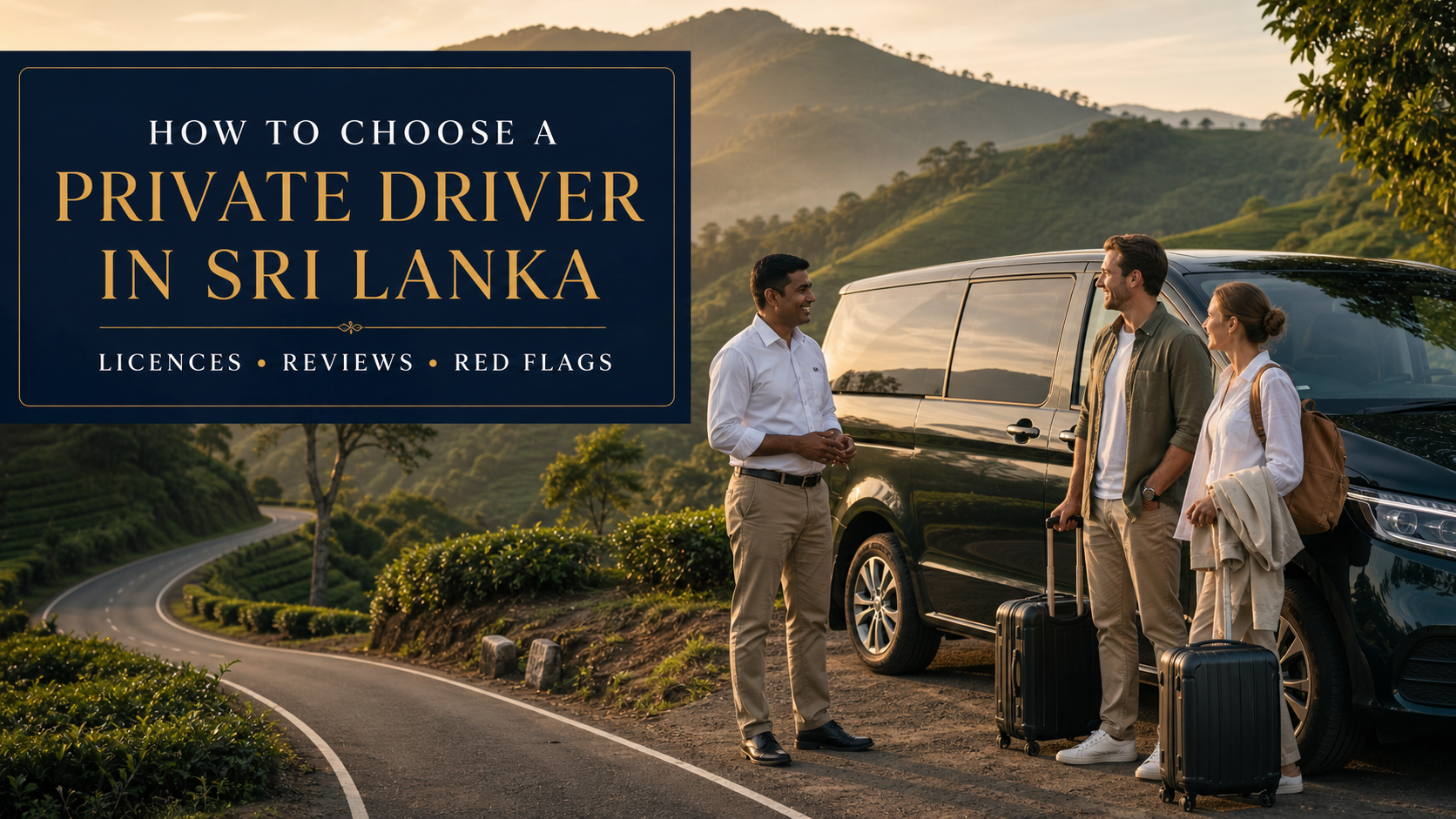
Travel journalist’s note
The best private driver in Sri Lanka is not automatically the cheapest, the most talkative or the person with the newest vehicle. It is the driver whose licence, reviews, vehicle, route plan and written terms make sense together — before the first travel day.
Search for the best private driver Sri Lanka and you will quickly find polished websites, WhatsApp recommendations, hotel contacts and enthusiastic social-media posts. Some lead to excellent drivers. Others give the traveller almost no way to compare credentials, vehicle quality or the real conditions behind the quote.
That uncertainty matters because a multi-day driver is not a ten-minute taxi. The person may meet you at Colombo Airport, carry your luggage from Sigiriya to Kandy, manage early starts in tea country and become the practical link between safaris, trains, hotels and the south coast. A good match makes the island feel easier. A poor match can shape every day of the trip.
This guide explains how to choose a driver in Sri Lanka without relying on price or star ratings alone. If you are still deciding whether a driver is the right transport style at all, start with our Sri Lanka transport comparison and the five practical reasons to hire a private driver.
Quick verdict
Four checks before any commitment
Current identity and the right service category
Recent evidence from a similar route
Real passenger and luggage capacity
Route, inclusions, hours and cancellation
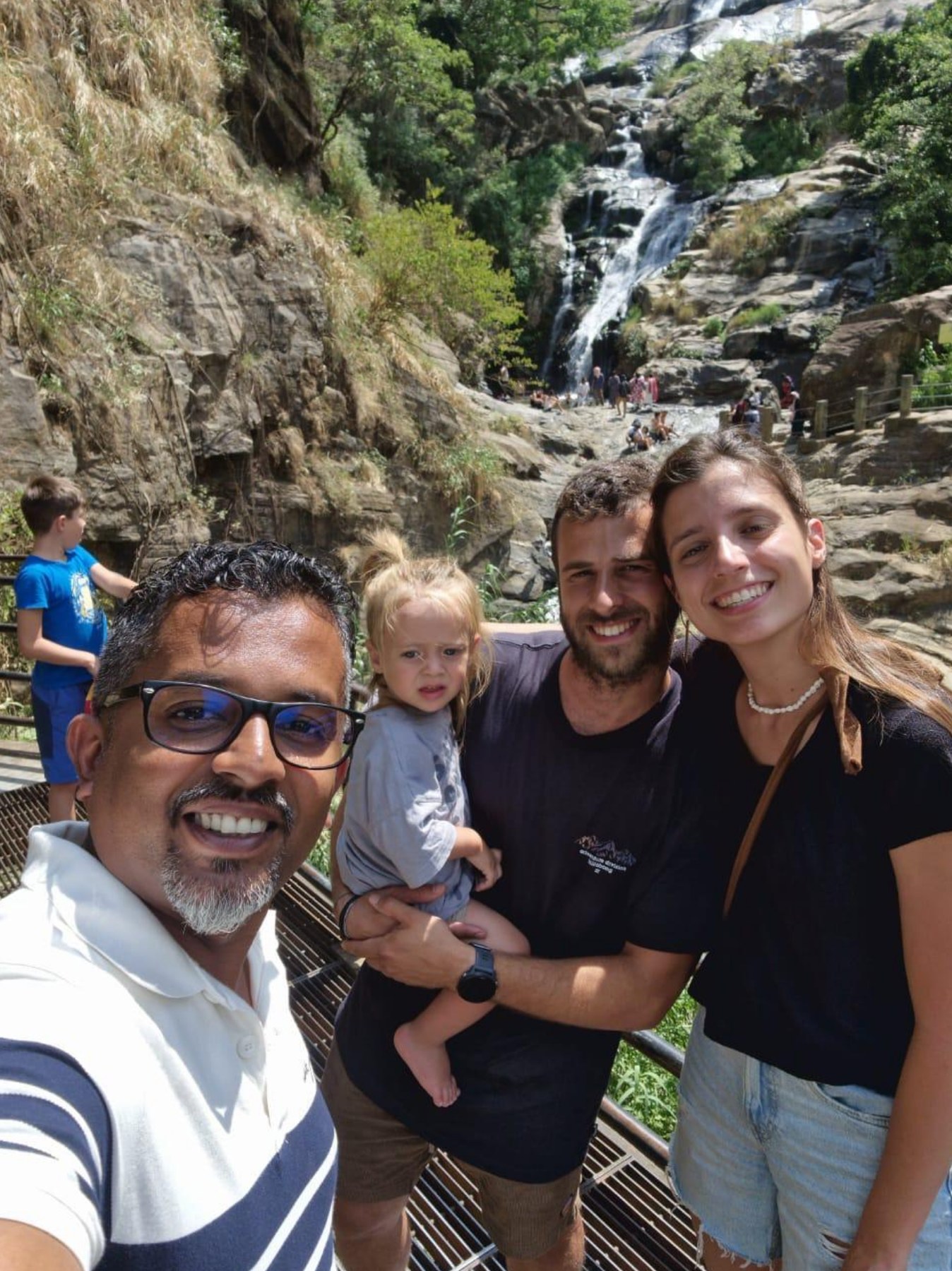
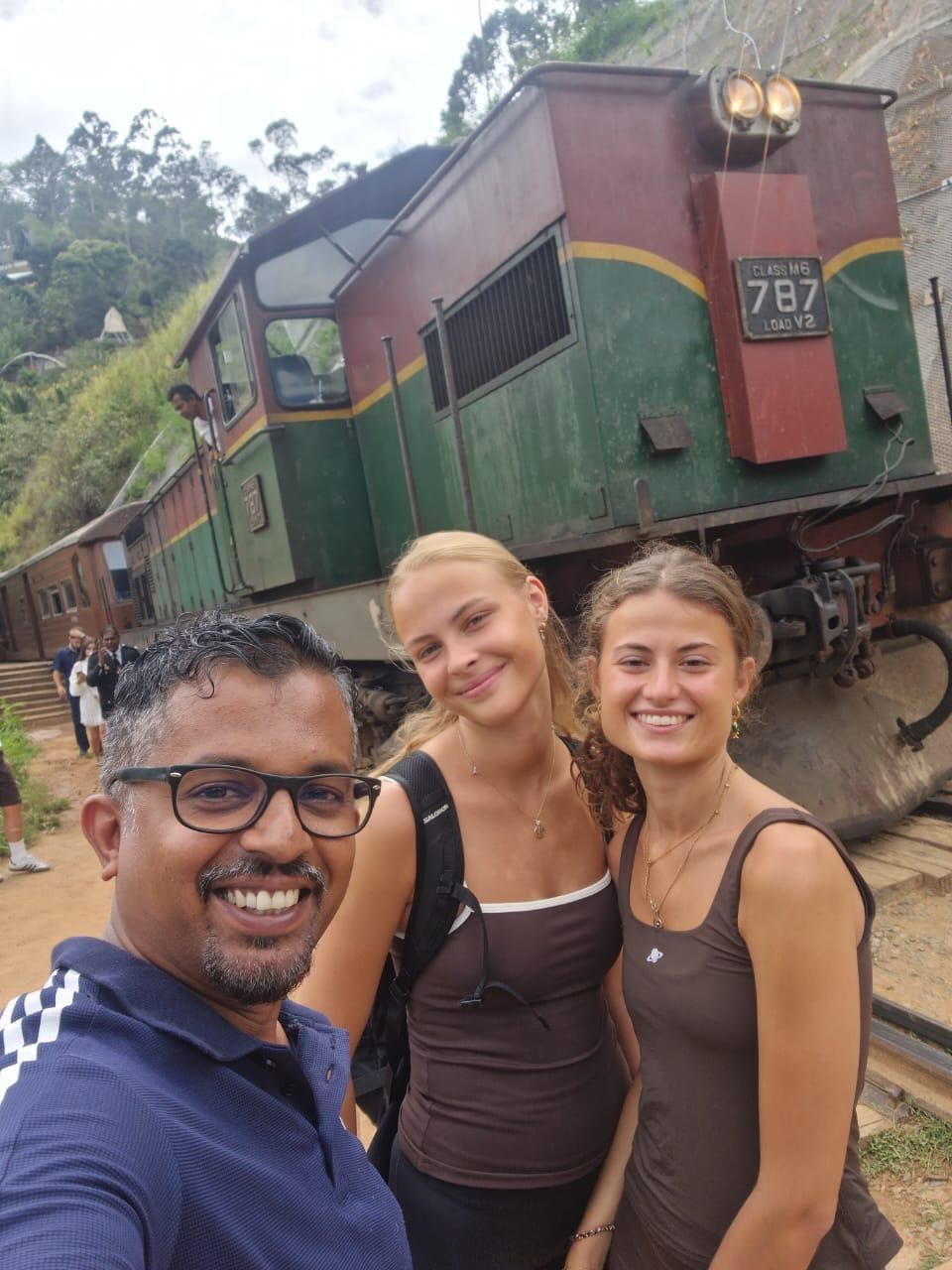
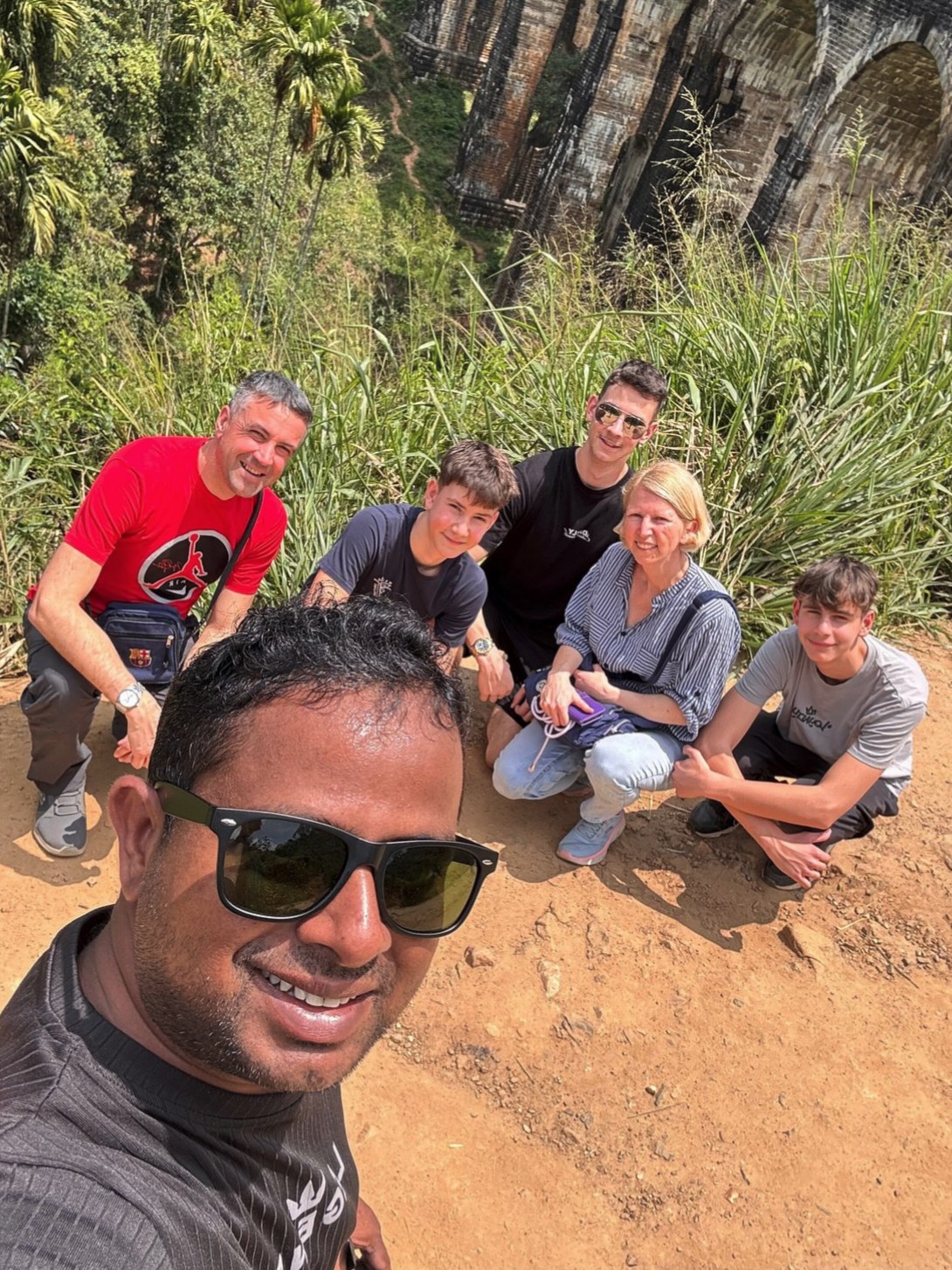
Real traveller moments
Choose for the route you are actually taking

What does “the best private driver” actually mean?
The word best is only useful when it is attached to your route. A quiet transport-focused driver may be ideal for a couple who has researched every temple and wants privacy. A chauffeur guide may add far more value for first-time visitors who want context at Anuradhapura, Polonnaruwa, Dambulla and Kandy. A large family may care more about a genuine luggage-capable van than formal guiding.
Start by writing a one-page trip brief: dates, pickup and drop-off, overnight towns, passenger ages, luggage, train sections, early starts, language needs and any mobility requirements. Send the same brief to every candidate. If each driver receives a different version of the trip, the prices and promises cannot be compared fairly.
The best driver is the clearest fit for your route, people and pace. Price matters, but clarity is what makes the price comparable.
Editorial view
1. Verify the licence — and understand what it covers
A licence is the first serious filter because it shows that the driver or guide has entered a formal tourism or driving system. It is not a complete quality guarantee. A valid credential does not tell you whether the vehicle is clean, the communication is calm or the driver has recently completed your route. Treat it as the beginning of due diligence, not the end.
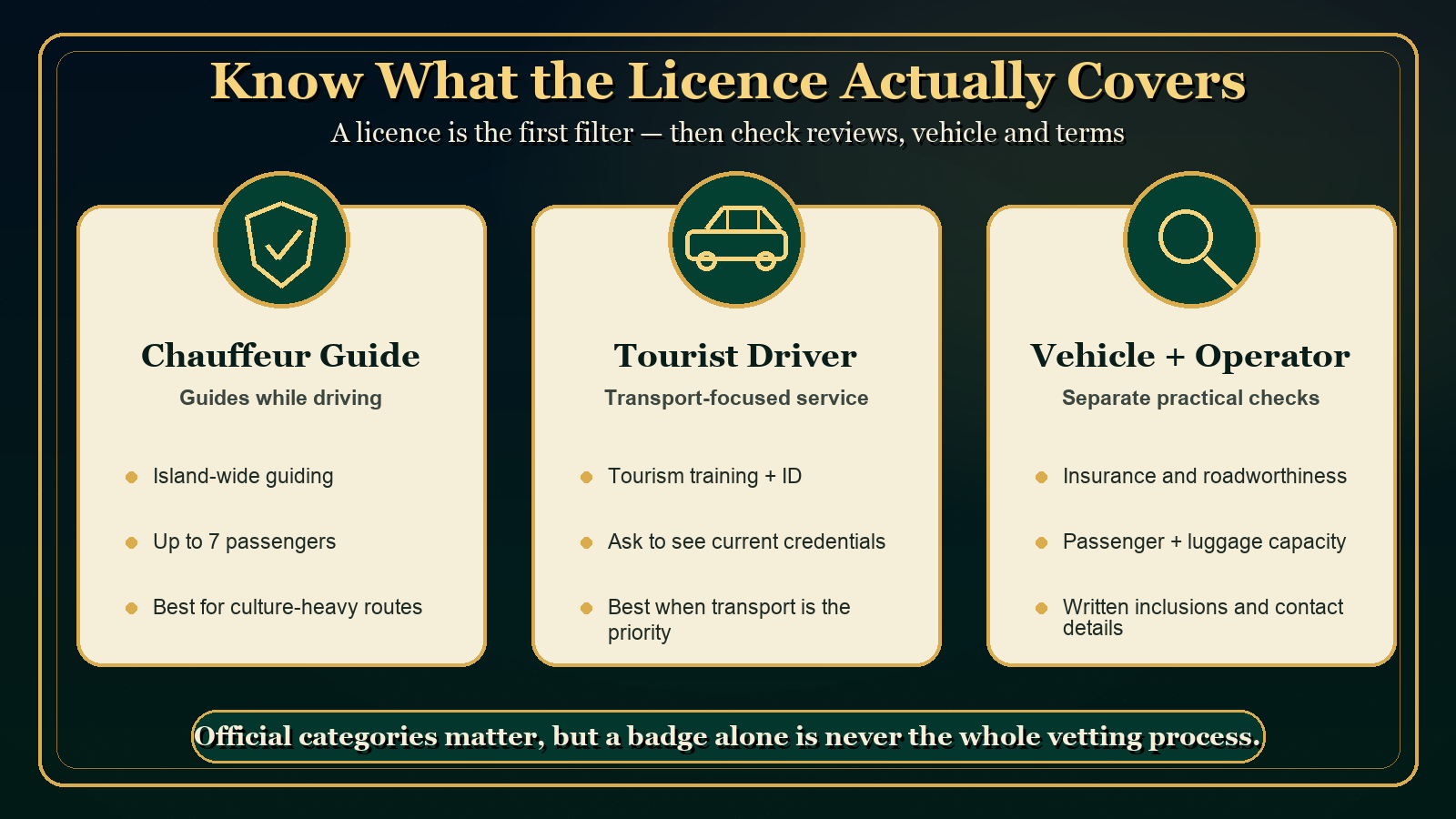
| Credential | What it tells you | Best fit | What to verify |
|---|---|---|---|
| Chauffeur Guide | A licensed guide who can guide while driving. The SLTDA notice describes island-wide coverage for groups of up to seven passengers. | Cultural routes and travellers who want explanations along the way. | Current SLTDA guide licence, language, guiding style and passenger limit. |
| Tourist Driver | A transport-focused tourism driver. SLTDA publishes training and identity-card information for tourist drivers. | Trips where safe, punctual transport matters more than formal guiding. | Current identity, driving licence, route experience and vehicle details. |
| Standard transport profile | Transport only; do not assume a tourism guide credential from the word “driver”. | Simple point-to-point transfers when the operator and vehicle are clear. | Legal driving entitlement, operator identity, insurance and written terms. |
Ask for a current, readable credential
Ask the driver to show the front of the current identity card or licence before confirmation, not only after airport pickup. Check the name, photograph, category and validity. If a platform profile says “Guide licence”, the document should support that claim. If the service is transport only, do not expect formal site guiding unless a separate guide is included.
Match the credential to the itinerary
LankaRide explains its profile categories on the driver types page. For a culture-heavy route, the ability to filter for a guide driver can save the traveller from assuming every English-speaking driver is also a licensed guide. For a beach or airport route, a transport-focused driver may be the more economical and appropriate choice.
2. Read reviews like an investigator, not a fan
Star averages are a shortcut, not a decision. A useful review tells you when the trip happened, where the traveller went, what vehicle was used and how the driver behaved when the plan changed. “Amazing driver!” may be genuine, but it cannot answer whether the person handled misty hill roads carefully or arrived before a 5:30 a.m. safari pickup.
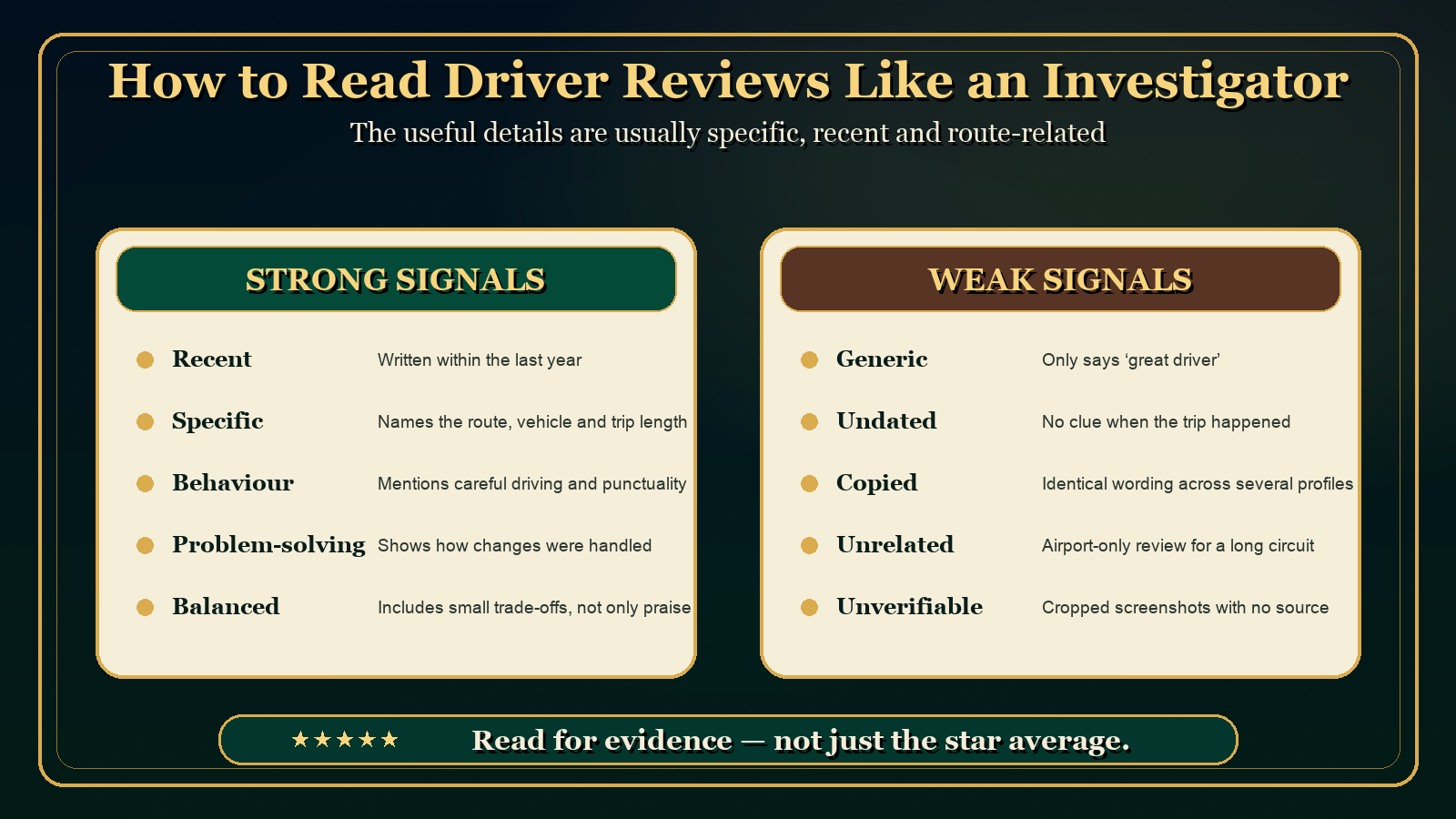
Prioritise reviews from a similar trip
For a ten-day circuit, look for reviews mentioning several hotels, luggage, early starts, tea-country roads and the driver’s behaviour over time. For a family, look for patience, seat-belt use, vehicle space and sensible breaks. For older travellers, look for careful boarding, realistic walking suggestions and a willingness to adjust the day.
Read the middle of the review
The most revealing sentence is often not the opening compliment but the detail in the middle: the driver waited when the train was late, changed the safari park after local advice, kept the vehicle clean or declined an unsafe late-night extension. Small operational details are harder to manufacture than generic praise.
Treat a lack of reviews as uncertainty, not automatic guilt
New drivers can be excellent, but the traveller should compensate for the missing evidence with stronger licence, vehicle and written-term checks. On a comparison platform, use the review section and profile information together rather than assuming a new profile is either unsafe or perfect.
3. Match the vehicle and driver to the real route
A sedan described as suitable for three passengers may not be suitable for three passengers plus three large hard-shell suitcases. A van can have many seats but limited luggage room once every seat is occupied. Ask for current interior and luggage-area photographs, then list the actual bags, child seats, wheelchairs, surfboards or photography equipment.
Vehicle condition also matters on long days: functioning air-conditioning, usable seatbelts, tyre condition, clean seating and the absence of persistent warning lights are more important than luxury branding. If an equivalent vehicle may be substituted, agree what “equivalent” means before booking.
Real taxi-charter guests
Check the actual driver, vehicle and usable space
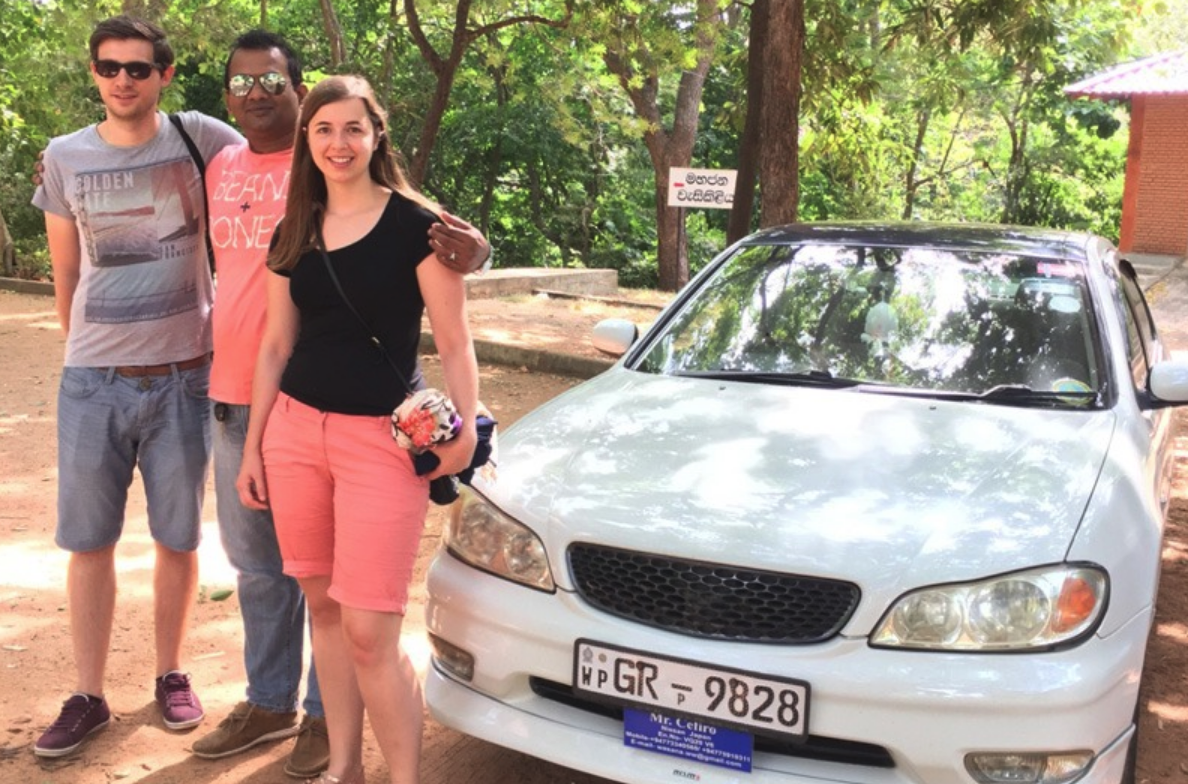
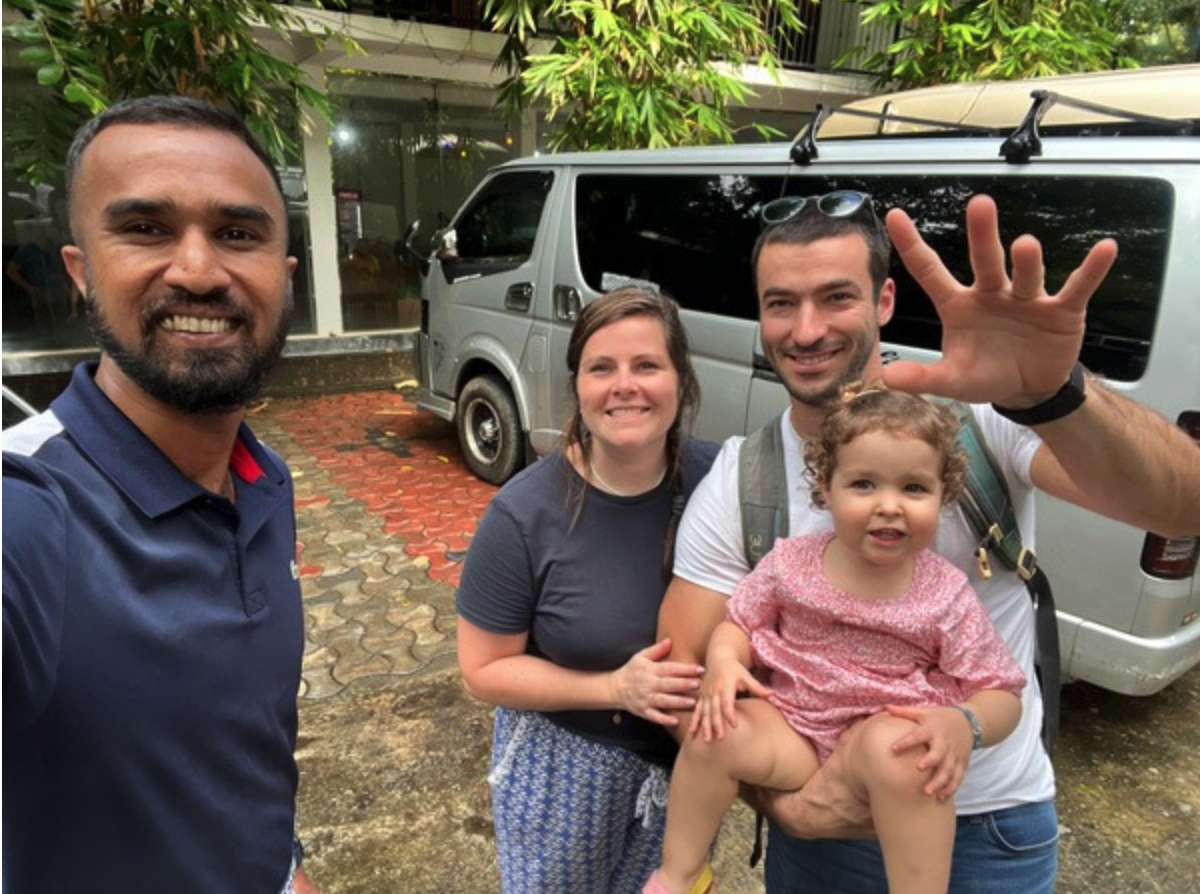
Route experience is different from general experience
Ask when the driver last completed the most difficult parts of your plan. Examples include Colombo Airport to Sigiriya after a late arrival, Kandy to Nuwara Eliya in rain, a Kandy–Ella train handoff with luggage, Ella to Yala before an early safari, and the south coast to the airport on departure day. A calm answer should include timing and trade-offs, not only confidence.
4. Compare written quotes line by line
The Sri Lanka car hire with driver cost guide explains why the day rate is only one part of the price. A serious comparison uses the same route and asks every driver to include the same categories. One quote may look higher because it already includes fuel, tolls, parking, taxes and driver accommodation; another may reveal those items only after the trip begins.
| Quote line | Clear answer | Question to ask |
|---|---|---|
| Route and dates | Every overnight base and the start/end points are named. | Does the price change if we add or remove a stop? |
| Vehicle | Model or equivalent, air-conditioning, seats and luggage capacity are stated. | Will this exact vehicle, or a true equivalent, arrive? |
| Inclusions | Fuel, tolls, parking, taxes and driver meals/accommodation are addressed. | What can appear as an extra cost? |
| Time and distance | Daily hours, included distance and repositioning are explained. | What happens after the included limit? |
| Payment and cancellation | Currency, payment timing and cancellation terms are in writing. | When is money due, and what is refundable? |
Save the final quote and route in a message or document that both sides can read. Clarify the currency and, if payment will be made in another currency, how the exchange rate will be determined. Ask who receives the payment and whether that person or company matches the profile.
5. Interview the driver before you commit
A short video or voice conversation is valuable because a multi-day hire is partly a communication relationship. You are not testing for perfect English. You are checking whether questions receive direct answers, whether the driver listens, and whether they can disagree with an unrealistic plan without becoming dismissive.
- Which licence or tourism identity do you currently hold, and may I see it before booking?
- Have you completed a route similar to ours in the last year?
- Which vehicle will be used, and can it carry our passengers and full-size luggage comfortably?
- What is included in the quote, and which costs could be added later?
- How do you handle the Kandy–Ella train if we want to ride one section with our luggage moved by road?
- What are your normal driving hours, rest-break approach and policy for late finishes?
- Will you suggest shops or activities where you receive commission, and can we decline them without pressure?
- What happens if the named driver or vehicle becomes unavailable?
Notice the manner as much as the content. Professional drivers can explain uncertainty: safari sightings are not guaranteed, mountain-road times change with weather, and a train handoff needs a backup. Absolute promises may feel reassuring, but realistic boundaries are usually a stronger sign of judgement.
10 red flags when choosing a private driver in Sri Lanka
A single red flag is often a reason to ask another question. Several together are a reason to pause and compare another candidate. The goal is not to treat every driver with suspicion; it is to avoid allowing friendliness or urgency to replace basic evidence.
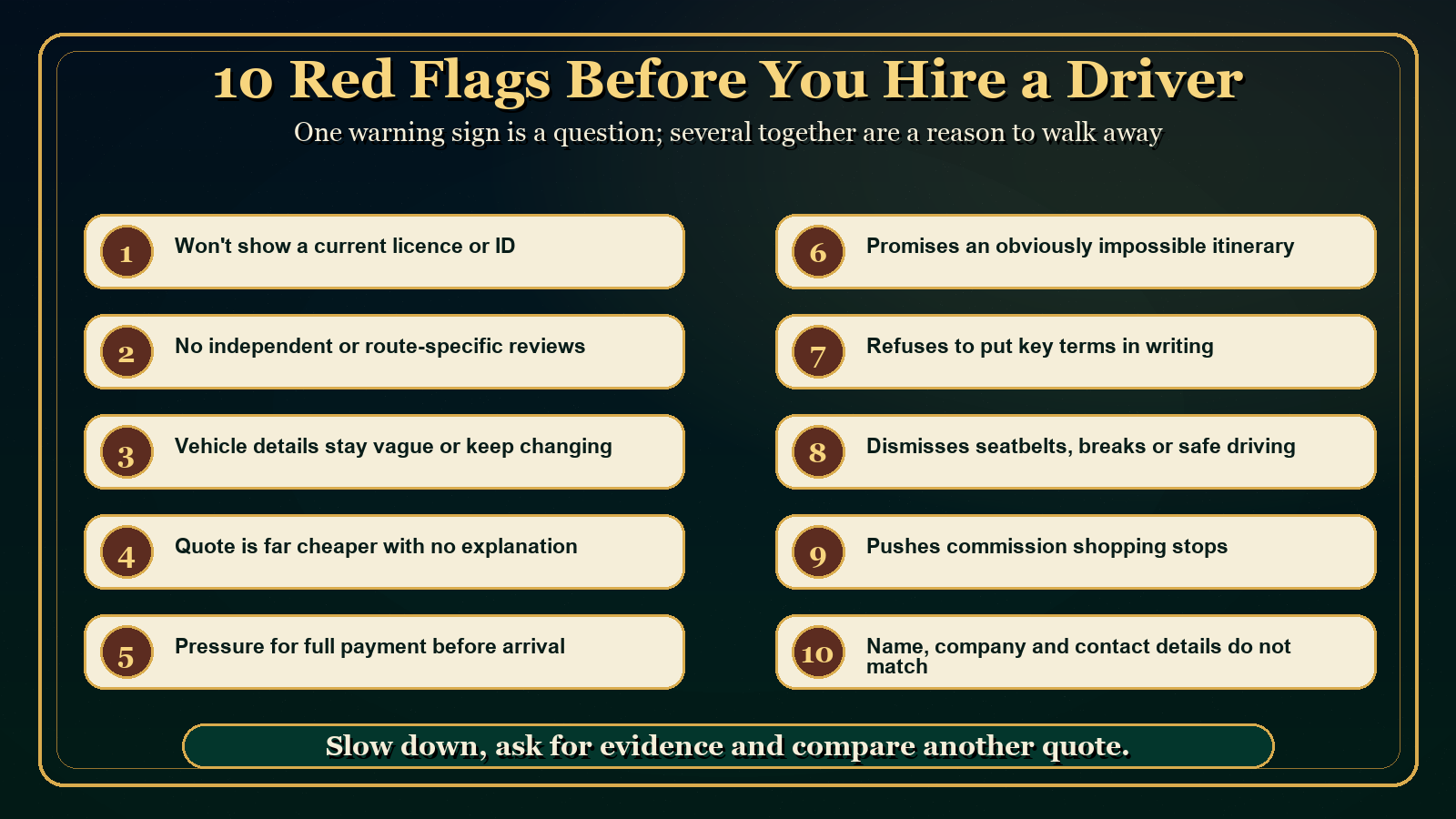
The driver avoids a simple credential check or sends an unreadable image.
Praise without dates, routes, vehicle details or a visible source gives little evidence.
“A good car” is not enough when four suitcases, child seats or older travellers are involved.
A low price may be genuine, but missing fuel, tolls, parking or driver accommodation must be explained.
Urgency and emotional pressure are poor substitutes for clear written terms.
A professional should challenge impossible days, unsafe night driving and unrealistic arrival times.
Keep the agreed route, price, vehicle, inclusions and cancellation policy in writing.
Seatbelts, rest breaks, vehicle condition and calm driving should not be treated as inconveniences.
Unrequested gem, spice, souvenir or activity stops can reveal conflicting incentives.
The profile, payment recipient, company name and person arriving should form one coherent story.
How LankaRide changes the comparison stage
As a travel editor, I would use LankaRide’s driver directory at the shortlist stage rather than treating it as a magic guarantee. The useful part is the structure: profiles can show driver categories, vehicle options, languages, prices and reviews in one place, which makes it easier to ask the same questions of several candidates.
The platform also allows travellers to request multiple quotes. That is especially valuable when the route contains several hotel changes or a guide-driver decision, because the traveller can compare like with like. The site states that no credit card or payment is required to book; travellers should still read the individual cancellation and payment terms shown for the chosen driver.
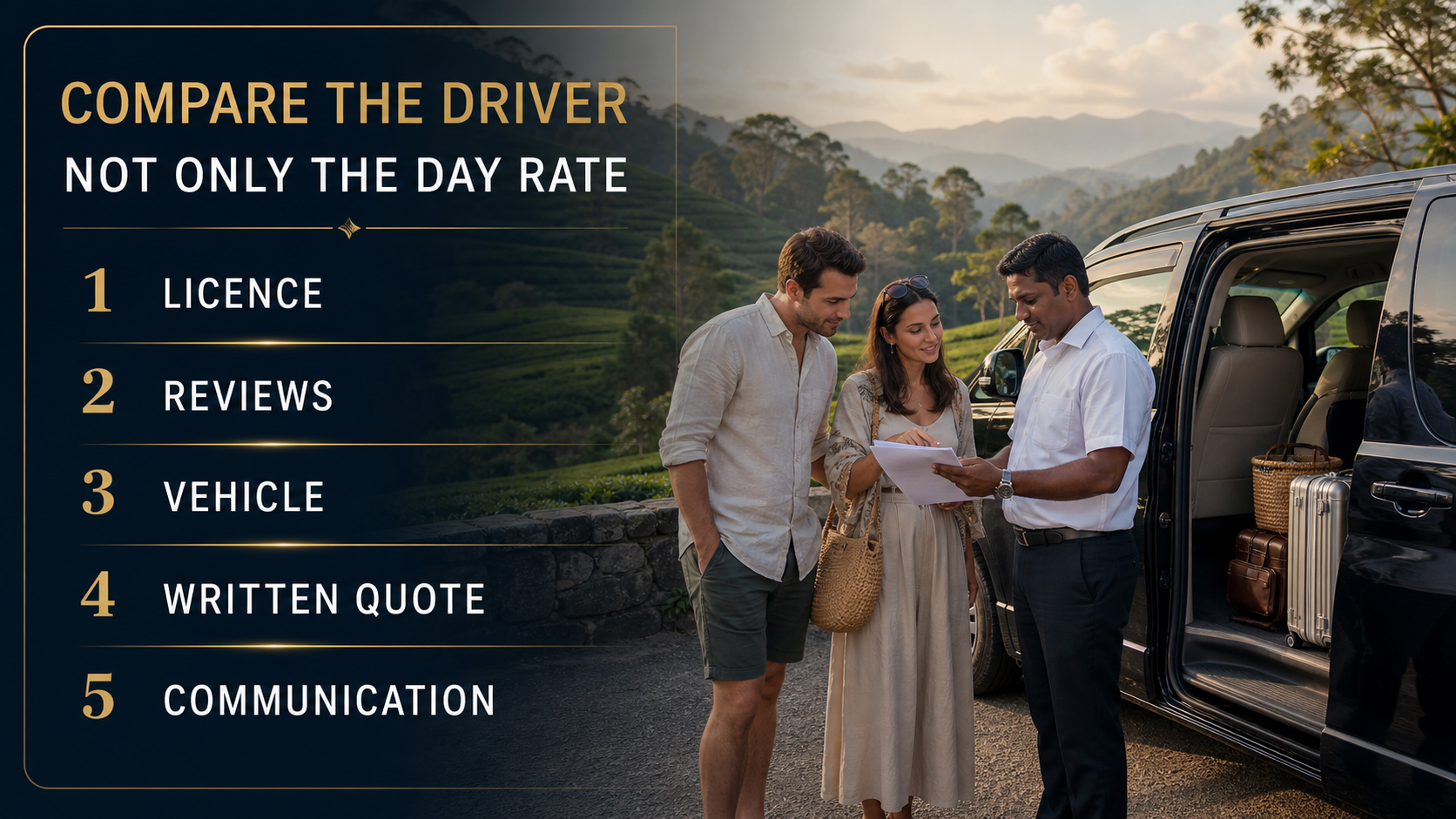
Final checklist before confirming
- The driver’s name, photograph and current credential match the person you expect to meet.
- Recent reviews describe a route and traveller type similar to yours.
- The named vehicle or equivalent has enough real luggage space and working air-conditioning.
- The route, included distance or hours, fuel, tolls, parking and driver accommodation are addressed.
- Payment timing, currency and cancellation terms are in writing.
- The driver answers safety and itinerary questions calmly, without pressure or impossible promises.
- Airport meeting details and a backup contact are confirmed before departure.
Final verdict
Choosing a private driver in Sri Lanka is not difficult when the decision is broken into evidence. Verify the credential, read reviews for specific behaviour, match the vehicle to the people, compare complete quotes and speak to the driver before commitment. None of those checks requires expert knowledge; they simply prevent one friendly message or low day rate from carrying too much weight.
For a first multi-region trip, the effort is worth it. The right driver does more than move the car: they make early starts possible, protect luggage during stops, reduce daily negotiation and help the route bend without breaking. The best choice is the one you can explain in clear terms before the journey starts.





 English
  French
  Spanish
  German
  Chinese
  Arabic